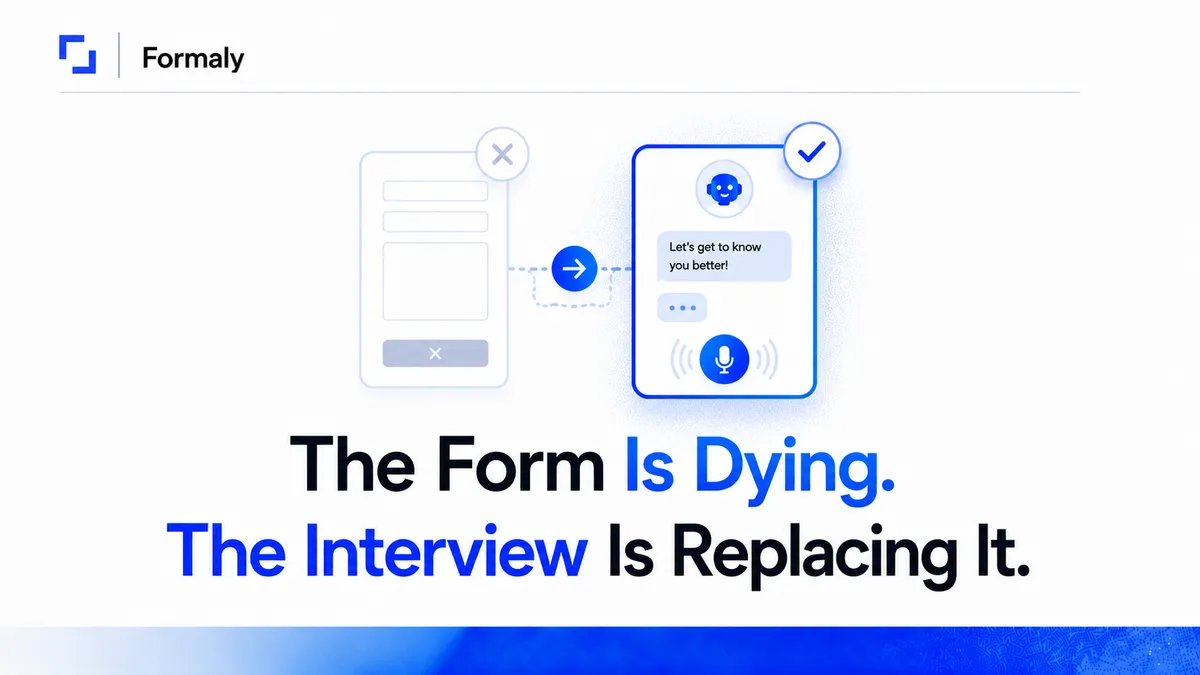
The form is one of the oldest interfaces we have.
It predates the web. Before there were input fields, there were paper forms: a fixed set of boxes, the same boxes for everyone, filled in alone and handed to someone who would read them later.
The web did not reinvent the form. It just made it faster to send and easier to store.
I want to argue something that sounds dramatic but I think is mostly obvious once you say it out loud.
The form was never the ideal way to learn something from a person. It was the only way that scaled.
That is no longer true.
Why the form won in the first place
If you want to understand a person, the best tool has always been an interview.
A good interviewer does not read questions off a card. They listen. They notice when an answer is thin and ask for more. They drop questions that stopped being relevant. They follow the interesting thread instead of the planned one.
Everyone knows this. It is why companies pay researchers to run user interviews, why journalists do not email a questionnaire, why a doctor asks follow-up questions instead of handing you a checklist.
So why did forms win anyway?
Because interviews do not scale.
You cannot put a skilled interviewer in front of ten thousand customers. You cannot afford to. So you do the next best thing. You freeze the questions in advance, strip out everything that needs judgment, and send the same rigid form to everyone.
The form is a compression artifact. It is what is left of an interview after you remove the parts that required a human in the room.
We got so used to the compression that we forgot it was a compromise.
The constraint just disappeared
Here is the shift.
The reason interviews did not scale was that asking a good follow-up question required a human. A human to read the answer, understand it, and decide what to ask next.
A language model can do that now.
Not perfectly, and not for every kind of question. But for the everyday work of feedback, research, and discovery, a model can read an answer, notice what is missing, and ask the obvious next question. It can do that ten thousand times at once without getting tired or bored.
The thing that made the interview unscalable is gone.
So the trade that created the static form no longer holds. We compressed the interview into a form because we had to. We do not have to anymore.
What an interview does that a form cannot
It is worth being specific about what we gave up, because it is more than people think.
A form asks everyone the same questions.
What could we improve?
An interview asks the question that actually applies to you.
You mentioned setup felt slow. Was it the install, or figuring out what to do after?
A form collects whatever the respondent decides to type, which is often three words.
An interview notices three words and asks for the fourth sentence.
"Pricing." Can you say more? Was it the total, the way it was structured, or that it was hard to predict?
A form treats every respondent as average.
An interview adapts to the specific person in front of it.
None of this is exotic. It is just what happens when something can listen instead of only record.
This is not "add a chatbot"
I want to be careful here, because the easy version of this idea is wrong.
The point is not that every form should become a chat window. Chat bubbles are not the insight. Plenty of conversational forms are worse than a clean static form, because they wrap a rigid script in a friendly costume and still refuse to listen.
The point is the listening.
An interview is not defined by its interface. It is defined by the fact that the next question depends on the last answer. You can run a real interview that looks like a chat, and you can run a fake one that also looks like a chat. The difference is whether anything is actually responding.
The form is dying not because text fields are ugly, but because "ask everyone the same fixed questions" is a workaround we no longer need.
What stays a form
Some things should stay forms, and they will.
When the respondent already knows exactly what to provide, an interview is just friction. Nobody wants a conversation about their billing address. Account creation, checkout, event registration, a compliance checklist: these are structured input, and a good static form is the right answer. Clear labels, fast completion, done.
The form is not disappearing from those jobs. It is disappearing from the job it was always bad at: learning something from a person it has not met.
That was never the form's strength. We just had nothing better that scaled.
What this means for Formaly
This is the bet underneath Formaly.
We built it so that a survey can behave like an interview when the question deserves one. You ask a rating, then the system asks why. If the answer is thin, it asks for more. If the respondent raises something you did not plan for, it can follow that thread instead of marching past it.
And it does that across thousands of respondents at once, which is the part that was never possible before.
I do not think forms vanish. I think the static form gets pushed back to the jobs it was always good at, and the work of understanding people moves to something closer to what we would have used all along if it had ever been affordable.
A conversation. At scale. With everyone who has something to tell you.
The form is not dead. It is just stepping back to its real size, and the interview is finally getting the reach it always deserved.